
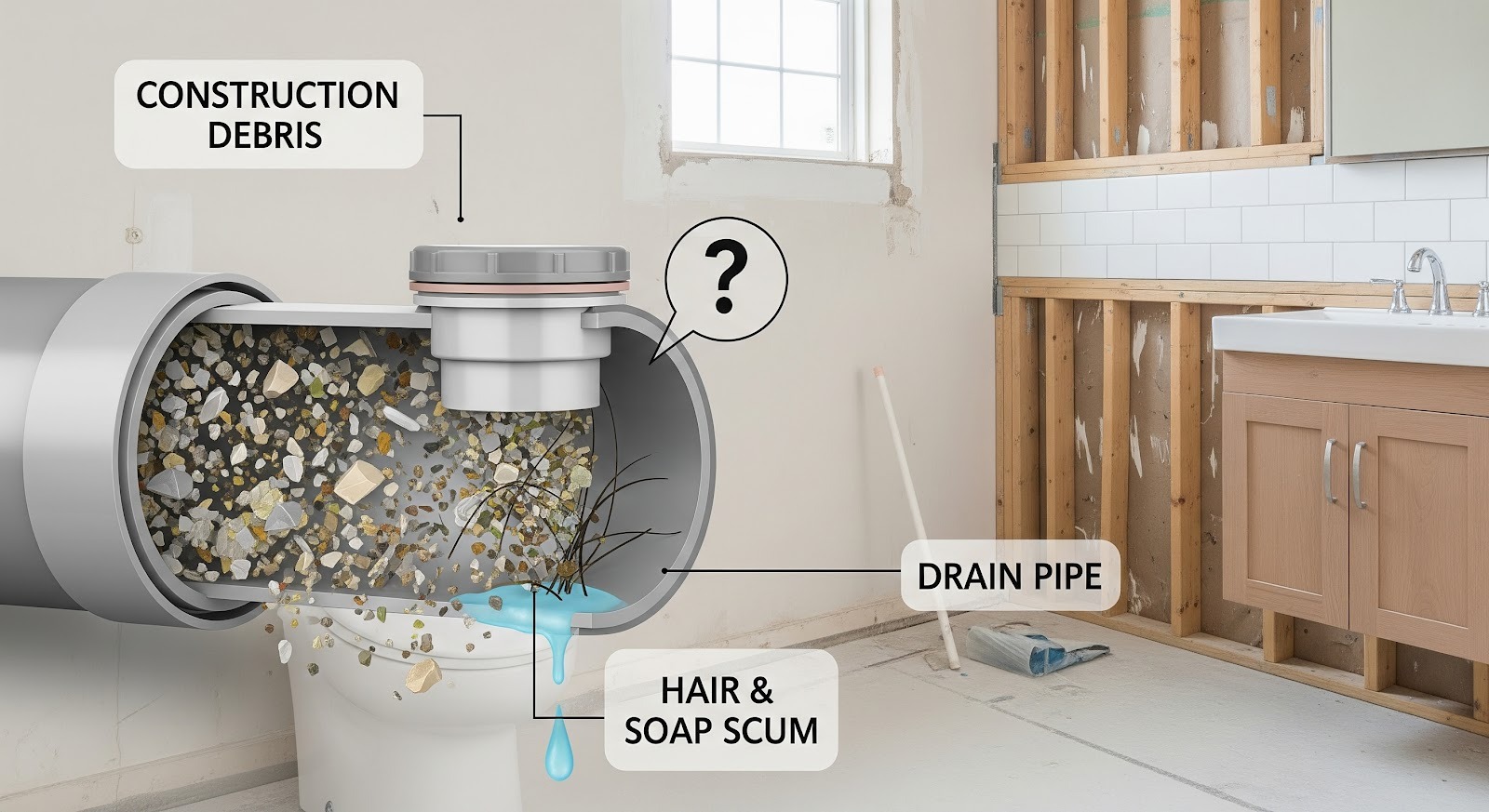
You would assume that you would have left behind your drainage problems after having invested thousands of dollars in plumbing improvements. But still somehow the same old backup occurs–and perhaps still more than ever. It is one of those frustrating situations that make the homeowners ponder on what has gone wrong and whether they have thrown their money on a solution that has not helped at all in improving anything.
The reality is the re-emergence of drain issues post-renovations is not unusual, and it normally indicates underlying problems that cannot be resolved by simple matters of quick fixes or part upgrades. We can consider why this occurs and what you can do about it in fact.
When Plumbing Upgrades Fail to Fix the Root Cause
Numerous plumbing operations are aimed at removing an apparent blockage or substituting a single section of pipe that has some issue. A plumber clears a stoppage, the water is turned on once more, and all proceed. However, until the root cause of such clog, such as improper pipe slope or aging material or even structural changes, is cleared, it is just a matter of time before the problem will be re-experienced again.
This is particularly widespread in older houses whose old clay or cast-iron piping has been repaired instead of being replaced. The system might be corroding in other areas even when one part is being retained by the use of modern PVC. Water has no discrimination, it will manage to find the least strong point. Sometimes, people in fast-growing neighborhoods find that as more homes pop up, the municipal sewer or water hookup just can’t keep up. When that system gets overloaded—like those blocked drains Northern Suburbs—it ends up causing bigger headaches for your own home’s plumbing.
Renovation Mistakes: Construction Debris and Poor Installation
Home improvements are very exciting yet they expose people to risks when there is a lack of care in plumbing jobs. The debris of construction such as grout, joint compound and at times even fine sawdust may find its way into the drains hardening with time resulting in obstructions which will not be removed by ordinary drain cleaners. Chemicals and solvents used in paint may wear away the inside of pipes, making them coarse and therefore easily trap debris.
Another culprit? Improper fitting pipe or fittings. Using pipes that are too small to support the flow of water in the home, or joining materials that do not fit each other without adapters, you are laying the groundwork to back-ups and pressure issues. These problems may not manifest themselves immediately but when debris begins to pile up at poorly bonded points or slow-draining spots then the problems become chronic.
The slope of the pipe is not as trivial as most people imagine. When the drainage lines are laid without the right gradient even a degree or two out of the right one, then the water and waste will not drain away evenly to the sewer line but collect in the low areas. The result is what plumbers refer to as a belly in the pipe; a depressed area which becomes the center of frequent clogs.
Drainage Challenges in Modern and Modular Homes
Older homes are not the only ones that experience such problems. The newer forms of construction, such as modular houses may have drainage quirks of their own. Modular and prefabricated houses are characterized by a smaller drainage pipe and small-scale layout of plumbing systems that are aimed at fitting the limited areas and minimize material expenses. Although this is logical in the building process, it implies that these systems are easier to clog with common debris such as hair, grease, and soap accumulation.
Another aspect is ventilation. Drain venting will make ample room in order to get water flowing freely. Poor venting may occur when it is not properly vented, which may occur with modular residences or improperly planned extensions, causing slow flowing drains, gurgling, and frequent post-cleaning backups. The machine cannot even breathe as it ought to.
Hidden Threats: Tree Roots and Pipe Misalignment
And at times it is not what you flushed or how the pipes got put in–it is what goes on outside your walls. Roots of trees are infamous in terms of moisture seeking and invading even the finest cracks within the underground sewer lines. Once in, they develop as aggressors forming blockages that bounce back soon after mechanical washing away since the root system has not been excised.
On the same note, the misalignments that form by pipes that have moved through ground settlement, seismic movements, or neighboring constructions may trap debris. Even minor angular movements are enough to interrupt the flow of water to the extent that they lead to chronic difficulties. In such instances, patching won’t suffice but a complete evaluation with pipe leak detection technology or camera scans is required to know and pinpoint the occurrence and cause of the system to fail.
The interior of old pipes is also rough and scaled because of mineral deposits, corrosion or chemical damage. These coarse surfaces trap debris which would otherwise move through smooth pipes. In case you are always experiencing slow drains even after cleaning the pipes, the rotting interior pipes may be the silent killer.
Why Chemical Cleaners and Snaking Are Only Temporary
When the water begins to reverse, one ends up grabbing a bottle of chemical drain cleaner. And maybe it would–in the short run. However, harsh chemicals are more ruinous than beneficial in the long run, corroding the walls of pipes and making them rough and pitted which in fact promote future clogs. What seems like a quick fix ends up in a loop of increasing blockages and subsequent pipe bursts.
There is also the repeated snaking or plunging. These techniques remove the shallow barriers, but do not remove the subterranean debris. In case the underlying cause is a misaligned pipe, intrusion of tree roots or structural damage, there will be no long-term solution to the issue with mechanical clearing. You are curing symptoms, not disease.
Permanent Solutions: Camera Inspections and Hydro-Jetting
The correct diagnosis is the beginning of solving repeat drain problems. Professional plumbers have such tools as camera inspection and hydro-jetting that help them see what is going on inside your pipes, and clear up what can be gathered up by hand tools. This will not only clear the blockage that is currently there but will also indicate whether you have damaged pipes, root penetration, or a design defect that requires remedies.
The solution, in other instances, is to substitute problem areas, or even complete piping, of old piping with new, corrosion-resistant and scale-free materials. It will be more of an initial investment, but it will remove the pattern of ad hoc solutions and emergency call ins. Consider it as a remedy of the under-structure, but not continually plastering on the face of it.
In the case of poorly-designed homes, i.e. without appropriate slope, inappropriate size of pipes, excessive sharp turns, etc.–the fix can be a redesign. It is not what anyone would like to hear when there is a mid-renovation news, but these structural problems can only be rectified with an aim of ensuring reliable and long-term drainage performance.
Solving Your Drainage Problems for Good
Post upgrade drains tend to be recurring issues that are not related to bad luck. It could be renovation debris that was never flushed out, pipes that were installed at the wrong slope, or infrastructure that was so old that it was not completely replaced, the trend all leads to unsolved root causes. It is all about knowing what is actually going on in your plumbing system, and not simply giving the most obvious symptom a response. When you put your money to the right diagnosis and full repairs, you are not fixing a drain, but in fact, you are fixing the issue.